Chaos arising from interacting traffic signals
Hideyuki Suzuki, Jun-ichi Imura, and Kazuyuki Aihara, “Chaotic Ising-like dynamics in traffic signals,” Scientific Reports 3, 1127 (2013).
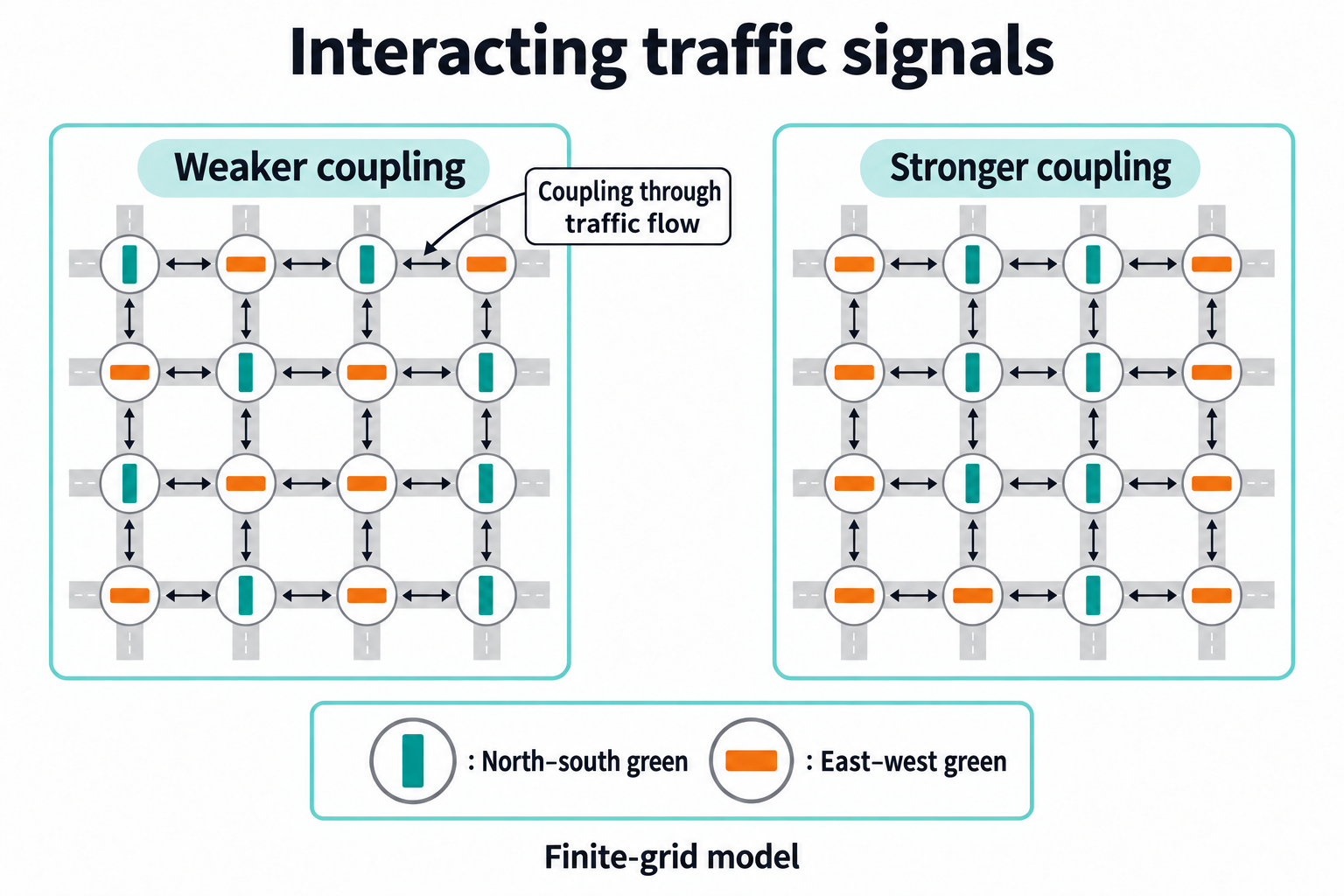
When traffic lights respond to local queues, traffic flow carries their influence to neighboring intersections. This study maps the two choices, green for north–south or east–west traffic, onto the two spin orientations of an Ising model. A simplified road grid lets the authors examine how local control produces collective behavior.
The contribution is a deterministic model in which individually periodic signals give rise to chaos and Ising-like collective behavior through coupling. Irregular fluctuations emerge without adding random noise, and stronger coupling favors alignment. Numerical evidence of a finite-size ferromagnetic transition provides a theoretical foundation for studying traffic signals using statistical physics.