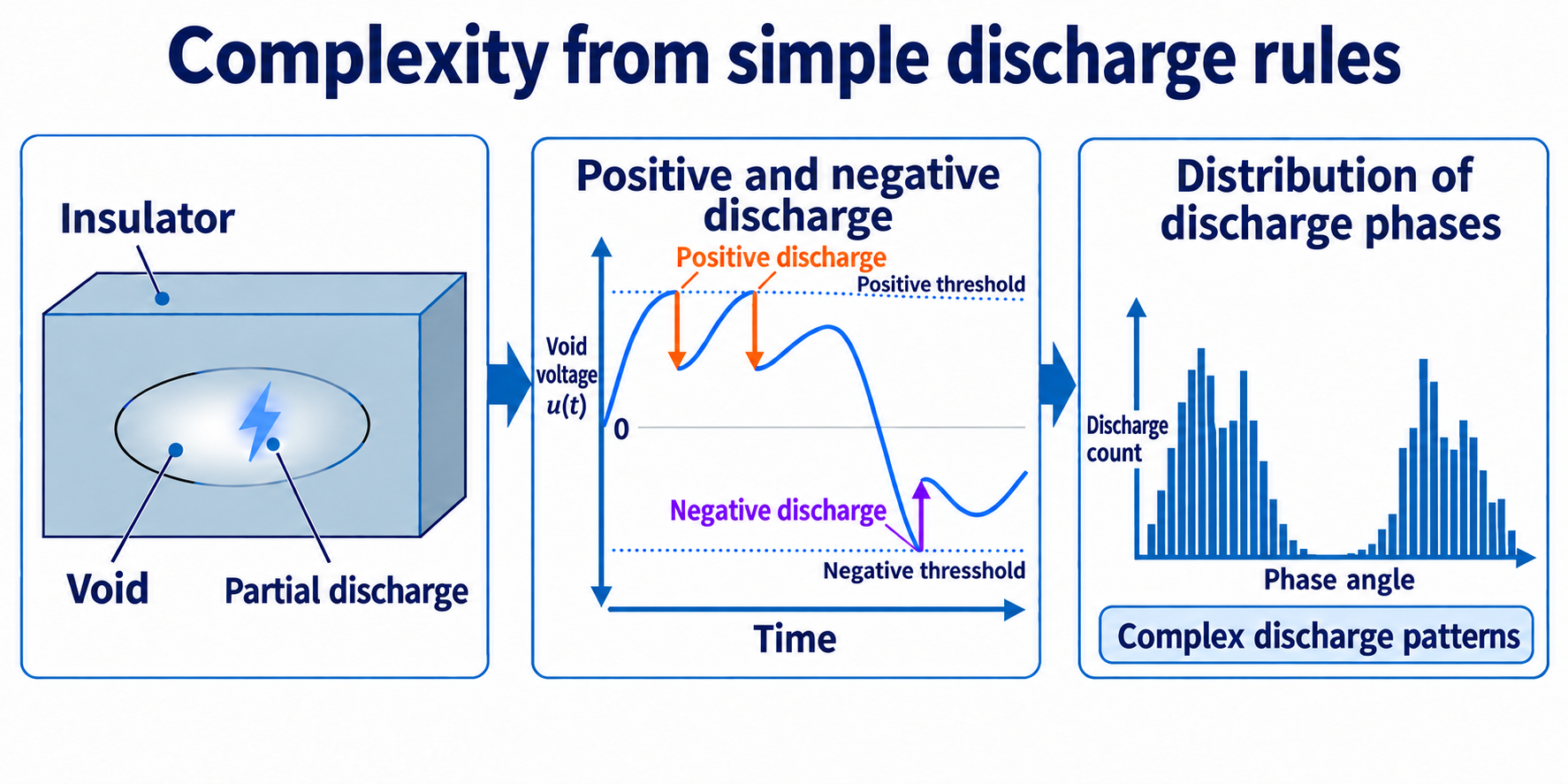
Why can a simple discharge model behave so intricately?
H. Suzuki, K. Aihara, and T. Okamoto, “Complex behaviour of a simple partial-discharge model,” Europhysics Letters 66, 28–34 (2004).
A small void inside an insulator can discharge when a high voltage is applied, even while the surrounding material remains insulating. Repeated partial discharges matter because they contribute to deterioration. This paper examines a basic equivalent-circuit model built from three capacitors. Under an AC voltage, the model produces both positive and negative discharges. Accumulating discharge counts by phase within the AC cycle provides a pattern used to investigate the condition of the insulation. If its parameters are fixed and random fluctuations are removed, should the relationship between applied voltage and discharge frequency become simple? The starting point is to determine how much complexity already resides in the simplest model before interpreting more complicated observations.
The study shows that even a deterministic, fixed-parameter model can produce an intricate dependence of the average number of positive discharges per AC cycle on voltage amplitude, resembling a devil’s staircase. Its analysis reduces repeated discharge events to a double rotation, a map with different displacements on different intervals. Self-similar structure in parameter space explains the discharge-rate response and complex discharge-phase distributions. A comparison with preliminary experiments also showed qualitative trends consistent with the model.