Combining optical computations to broaden the problems a machine can tackle
Hiroshi Yamashita, Ken-ichi Okubo, Suguru Shimomura, Yusuke Ogura, Jun Tanida, and Hideyuki Suzuki, “Low-Rank Combinatorial Optimization and Statistical Learning by Spatial Photonic Ising Machine,” Physical Review Letters 131, 063801 (2023).
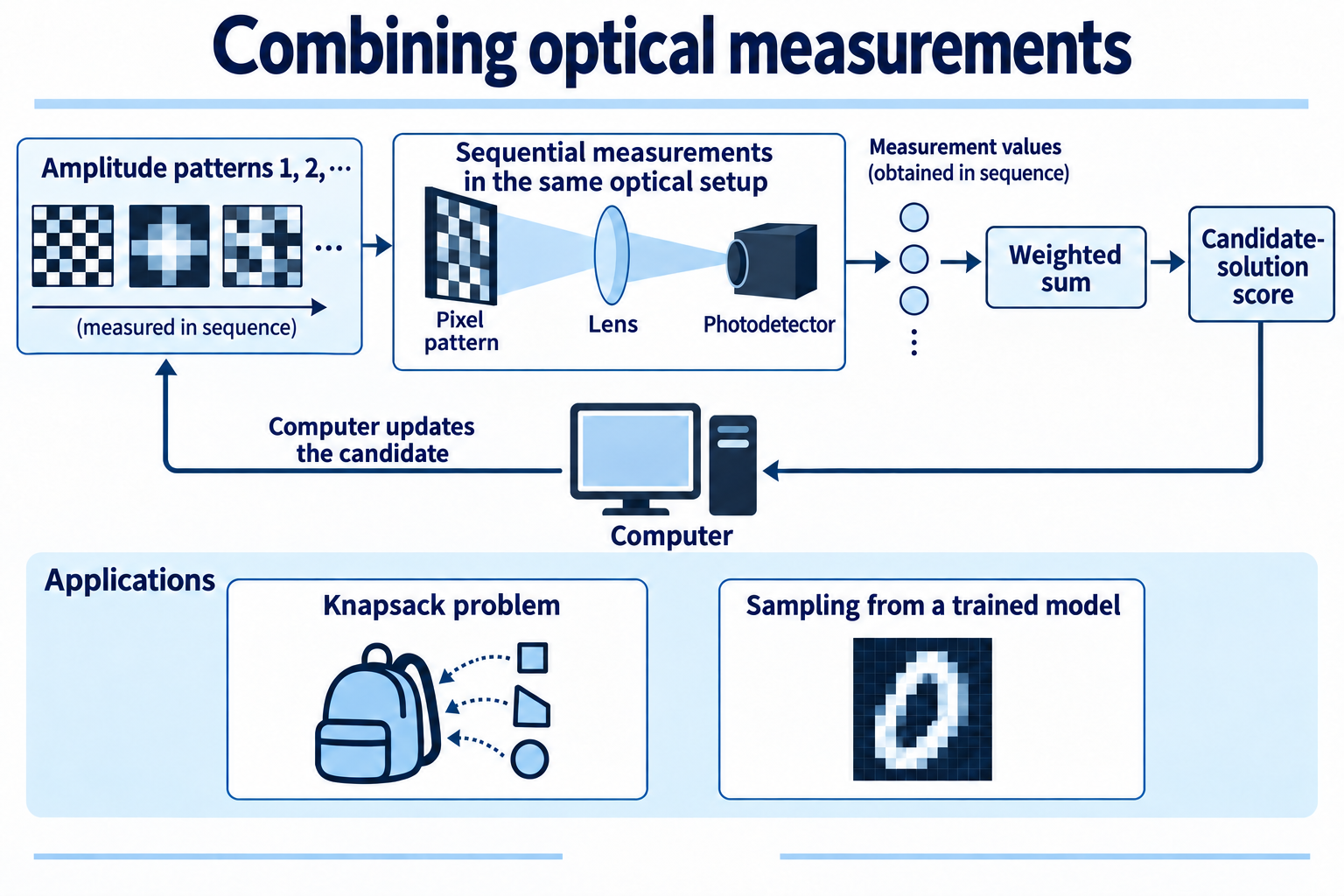
Choosing valuable items without exceeding a weight limit is a combinatorial problem. A spatial photonic Ising machine evaluates candidate solutions using optical interference, but its basic form supports only restricted interactions between variables. This study broadens that scope without changing the optical layout: measurements made sequentially with different amplitude patterns are combined in a weighted sum.
The contribution is a multicomponent computing model and learning rule that extend rank-one interactions. Low-rank problems, expressible with few components, require fewer measurements per evaluation. The authors test a rank-two knapsack formulation optically, demonstrate handwritten-digit learning and classification numerically, and sample the digit “0” from a trained model in an optical experiment.