Understanding double rotations through reduction to the same form
Hideyuki Suzuki, Shunji Ito, and Kazuyuki Aihara, “Double rotations,” Discrete and Continuous Dynamical Systems 13, 515–532 (2005).
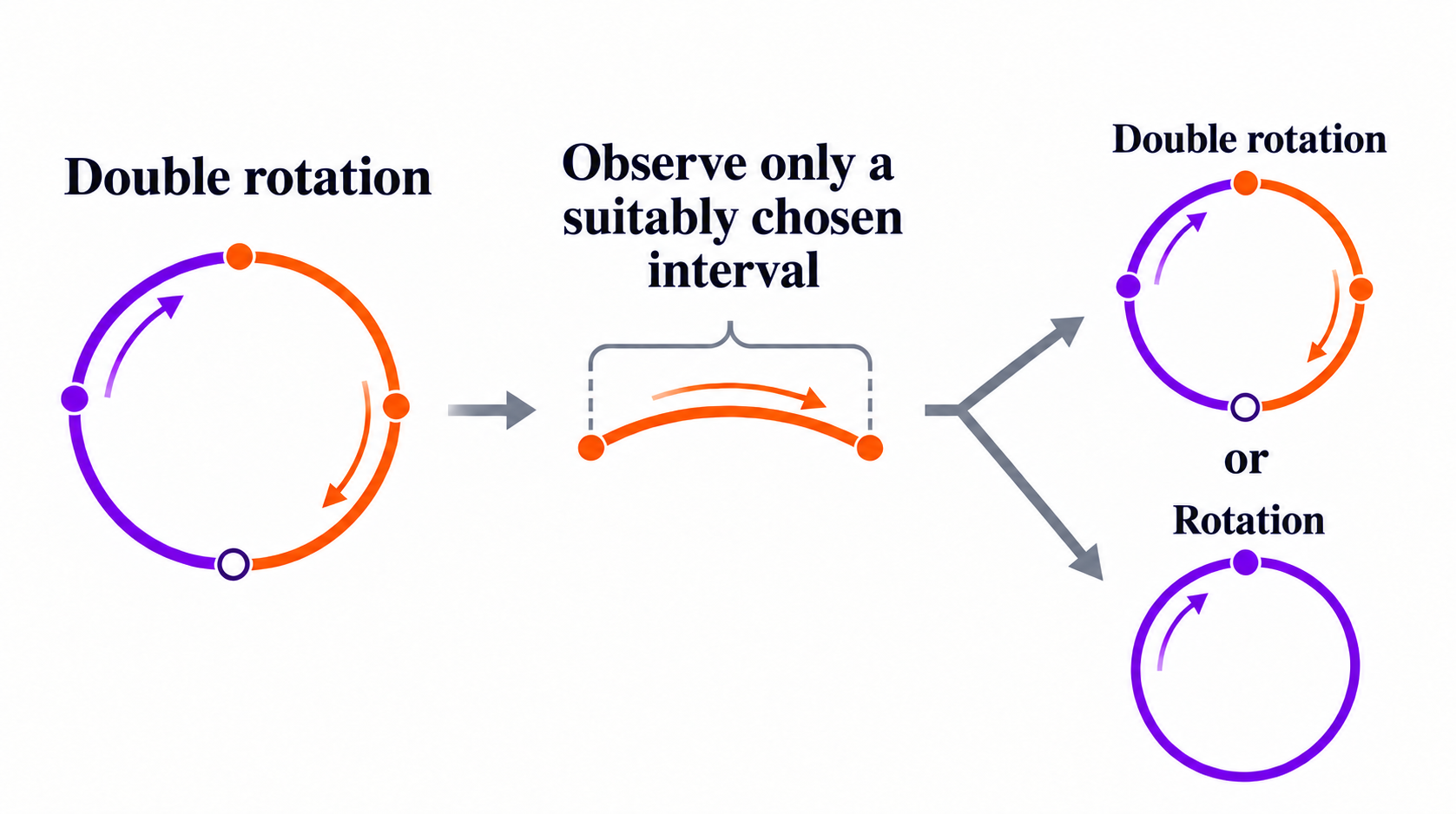
An ordinary rotation moves a point around a circle by the same amount at every step. A double rotation divides the circle into two arcs and chooses the displacement according to which arc contains the point. These simple rules generate self-similar complexity as their parameters change. To understand it, the paper observes only the moments when a point returns to a selected interval. After rescaling that interval, the same form of rule can appear again: another double rotation. The striking idea is that the problem returns to the same mathematical family, allowing the analysis to be repeated.
The authors construct this reduction using induced maps and show that it yields either a double rotation with transformed parameters or an ordinary rotation. Returning to the same form makes repeated reduction possible, providing a way to analyse self-similar structure in parameter space. They also study the discharge number, the long-run fraction of visits to one arc when the limit exists, and connect its intricate dependence on the dividing point to that structure. The central contribution is to turn reduction back to the same family into an analytical tool for understanding complex structure and long-term statistics.