Can deterministic dynamics perform probabilistic computation?
Hideyuki Suzuki, Jun-ichi Imura, Yoshihiko Horio, and Kazuyuki Aihara, “Chaotic Boltzmann machines,” Scientific Reports 3, 1610 (2013).
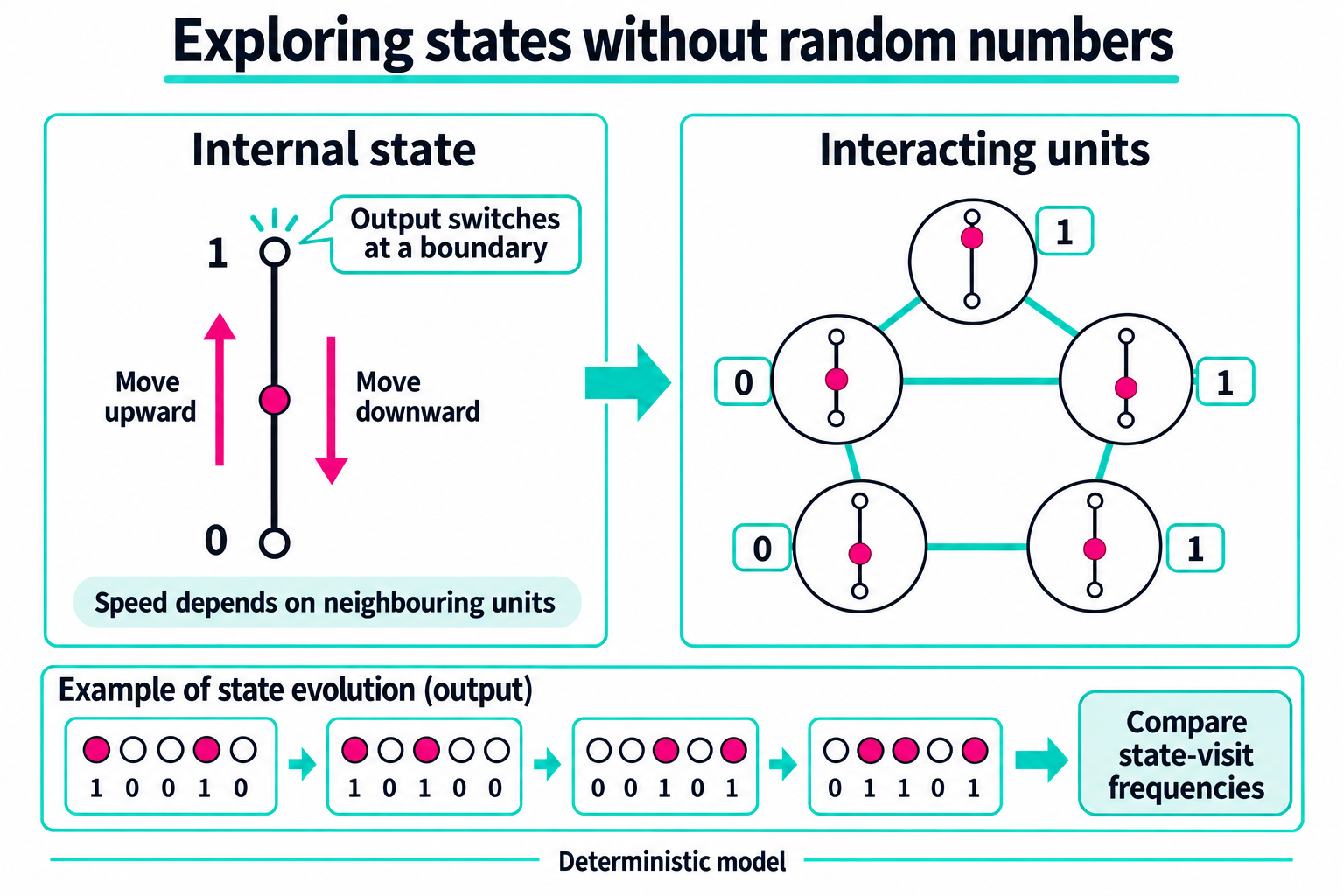
A Boltzmann machine consists of interacting units that take values of either 0 or 1. Ordinarily, random choices drive their updates, letting the system explore different configurations. Can it perform similar computation without random numbers? This paper gives each unit a continuous internal state that travels between two boundaries; reaching a boundary switches its binary output. Its speed depends on the other units, producing complex collective motion. The question is whether the statistics accumulated along these deterministic trajectories resemble those of the intended probabilistic model.
The contribution is a deterministic construction combining continuous motion with discrete switching, tested numerically on maximum-cut problems and the two-dimensional Ising model. The reported solutions and statistics are comparable to those of conventional Boltzmann machines. This is numerical evidence, not a proof that the interacting system exactly samples the Gibbs distribution. Nor does the paper establish a speed advantage on ordinary computers. Its prospective hardware value comes from parallel evolution without random-number generation.