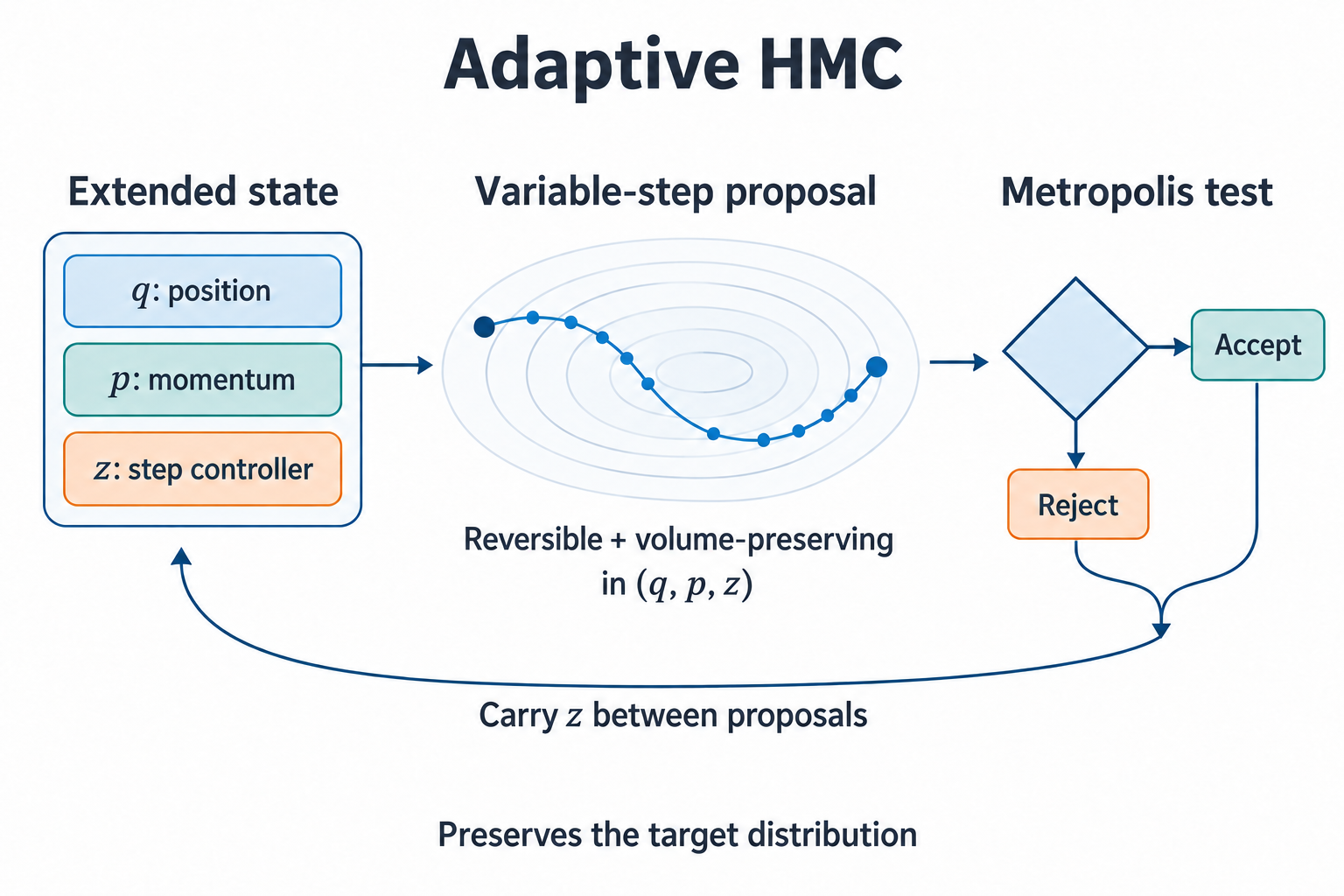
Can HMC adapt its step size while preserving the target distribution?
Michiko Okudo and Hideyuki Suzuki, “Hamiltonian Monte Carlo with explicit, reversible, and volume-preserving adaptive step size control,” JSIAM Letters 9, 33–36 (2017).
2018 Paper Award, Japan Society for Industrial and Applied Mathematics
Hamiltonian Monte Carlo (HMC) constructs candidate samples by simulating motion through a landscape defined by a probability density. Its integration step size affects how far it can move and how accurately it follows that motion. Changing the step size along a trajectory seems useful, but doing so carelessly can invalidate the sampler’s target distribution. How can adaptive integration and correct sampling work together?
This study makes the step-size controller an additional random variable, z, alongside position q and momentum p. By carrying z between proposals and assigning it a target density, the method uses explicit updates that are reversible and preserve volume in the enlarged (q, p, z) space. A Metropolis acceptance rule preserves the desired target distribution; the paper establishes stationarity through modified detailed balance. The construction also permits momentum-dependent step-size control.
On a 200-dimensional, two-component Gaussian mixture, the method produced a mean effective sample size of 15.0 versus 9.2 for standard HMC for the tested observable, with comparable acceptance rates. Runtimes were 14.0 and 13.0 seconds per 10,000 samples. The results demonstrate a promising framework; performance on other distributions and choices of time transformation requires further study.